

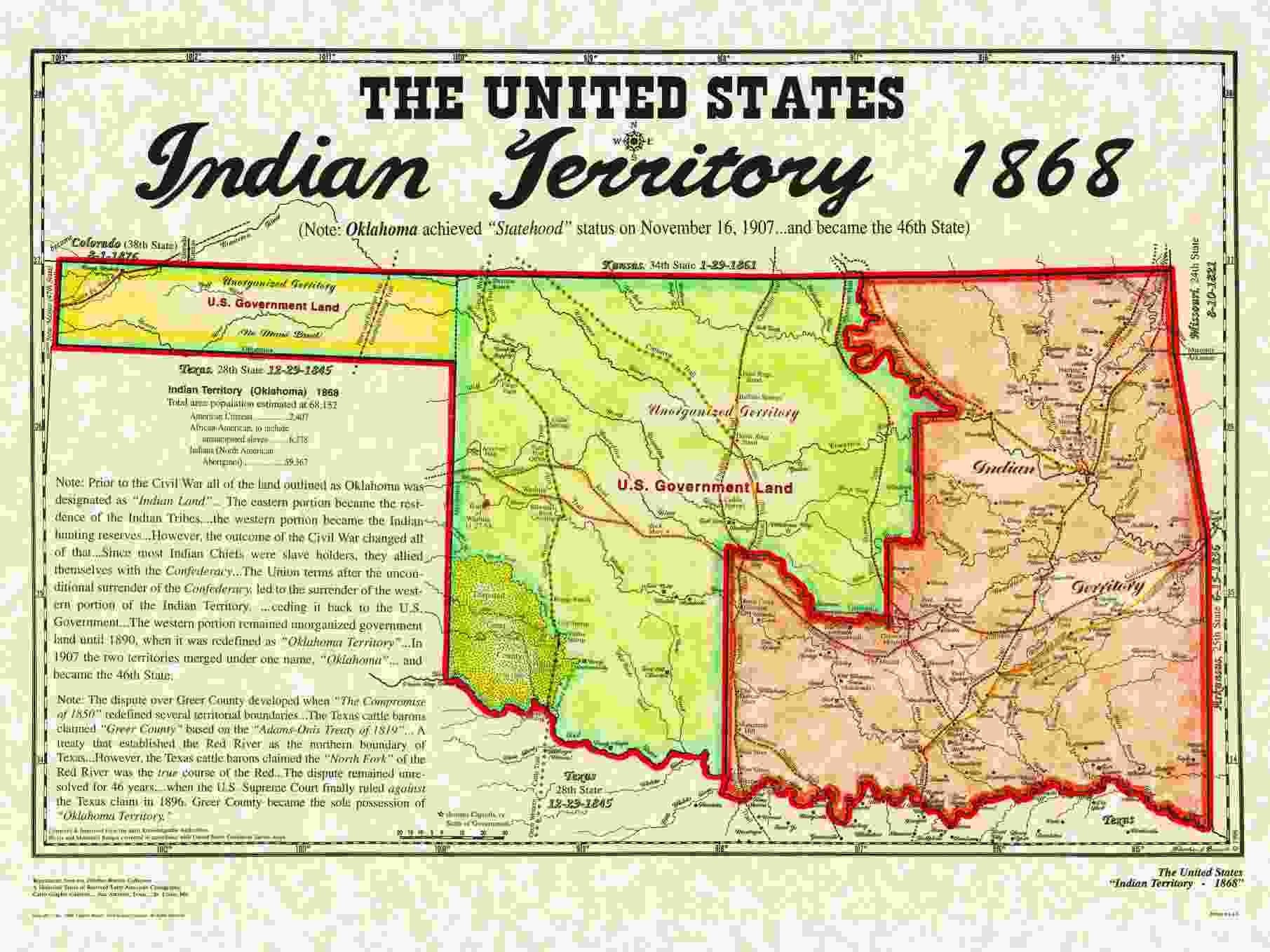
Pictured: OK and Indian Territory
Jurisdictional Disputes in Oklahoma Territorial Days
By Steve Byas
As more and more non-Indians began to live in “Indian Territory” in the latter days of the 1800s, problems relating to jurisdiction of criminal law became increasingly common. For example, there was an instance where a member of the Cherokee tribe attempted to kill his sister’s husband. Jim Kesterson had abandoned her, and Zeke Proctor said, “I am going to kill me a white man.” Unfortunately, he shot a relative instead.Federal marshals from Fort Smith, Arkansas, showed up at the trial in the Indian courts to arrest Proctor if he were found not guilty. Some relatives entered the courtroom, leading to a shoot-out between federal marshals and Indian police, resulting in eight deaths.
This type of jurisdictional dispute became a more pressing issue as the territory moved closer to statehood in 1907.
Beginning in 1890, Congress began enacting a series of laws to establish a uniform legal system for tribal members and non-tribal members alike. They began dismantling the tribal government, and extinguishing their title to land in the territory. Finally, Indians were incorporated into a new political community known as the state of Oklahoma.
This required terminating the Indian legal systems with a legal code and court system that applied equally to all persons. Congress subjected all of Indian Territory to specified federal criminal laws. For those offenses not covered by federal law, Congress provided that the laws of Arkansas would apply in Indian Territory. Eventually Congress declared that the laws of the United States and the state of Arkansas “shall apply to all persons” in the territory, “irrespective of race.” This applying the laws of a neighboring state to a territory — until it became a state — was a common practice of the time.
As it became clear that the territory was going to be incorporated into a new state, several statutes enacted by Congress made it clear the intention was to disestablish the governments of the Five Civilized Tribes. In 1906, The Five Tribes Act provided for the “final disposition of the affairs of the Five Civilized Tribes.” All tribal taxes were abolished and the Secretary of the Interior was directed to assume control over the collection of all remaining tribal revenues, distributing them to individual tribal members.
By the time of statehood – November 16, 1907 – there were no tribal courts, no tribal law, and no tribal fiscal affairs. The next year, Congress amended the Five Tribes Act to require tribal officers and members surrender all remaining tribal property, money, and records.
The 1898 Curtis Act had already abolished all tribal courts, and replaced tribal law with local law in other matters, such as inheritance and marital disputes. It established municipalities to govern both Indians and non-Indians, and that any city or town with at least 200 residents could be incorporated with all the powers and all the rights of municipalities under Arkansas law. All inhabitants – “without regard to race” – were made subject to all towns laws, but were also declared to possess “equal rights, privileges, and protection.” No person, whether white or black, or Native American could be denied equal rights before the law.
In 1906, Congress passed the Oklahoma Enabling Act, stipulating the conditions under which the territory of Oklahoma could be admitted into the federal union as the 46th state. Several members of the various tribes were elected to the Constitutional Convention, with the lawyer for the Chickasaw tribe, William H. Murray – who had married the niece of the governor (chief) of the tribe – winning election as the president of the convention. Much of the Constitution’s provisions, for good or bad, were his handiwork.
Murray was later, in 1930, elected governor of Oklahoma, having previously held the post of speaker of the Oklahoma House of Representatives. He also represented his congressional district in the U.S. House of Representatives. In 1950, his son, Johnston Murray, who was one-half Chickasaw, was also elected governor of Oklahoma. William H. Murray did the honors of swearing in his son, making them the only father and son team, thus far, in state history.
Steve Byas is editor of the Oklahoma Constitution newspaper and the Chairman of the Department of History at Randall University, where he teaches Oklahoma History.



Latest Commentary
Thursday 30th of April 2026
Thursday 30th of April 2026
Thursday 30th of April 2026
Thursday 30th of April 2026
Thursday 30th of April 2026
Thursday 30th of April 2026
Thursday 30th of April 2026
Thursday 30th of April 2026
Thursday 30th of April 2026
Thursday 30th of April 2026
Thursday 30th of April 2026
Thursday 30th of April 2026
Thursday 30th of April 2026