

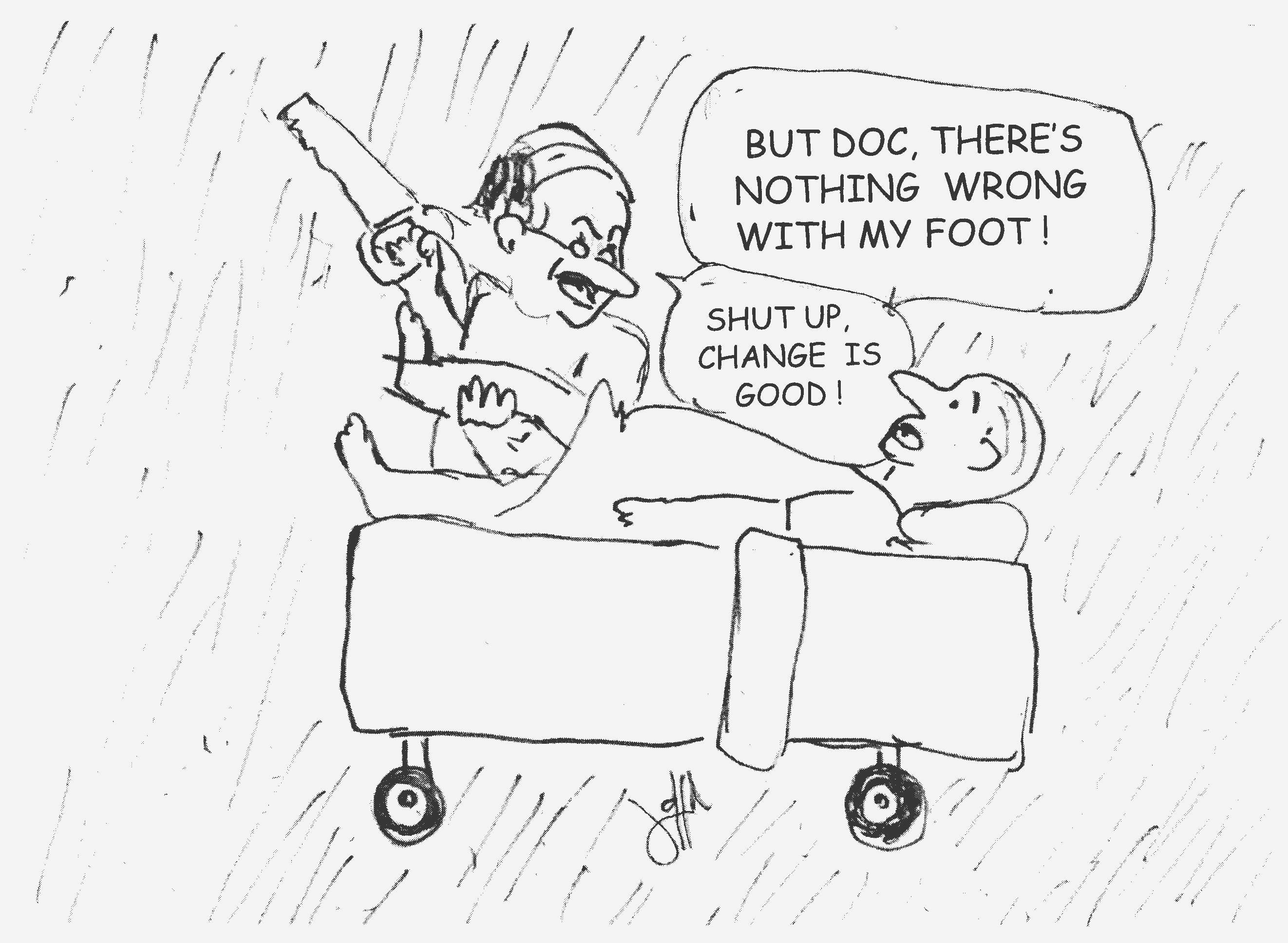
Pictured: Cartoon by John Greening
Worshiping at the Altar of Change
By Steve Byas
One of the marks of a liberal is supposed to be a favorable attitude toward change. Conservatives, on the other hand, are often denigrated for being “against change.” It is better to say that conservatives are “cautious” about change, rather than being against change.Actually, even those who consider themselves conservatives – and often are conservatives – get caught up in this worship of “change.” You have probably heard the little put-downs. Someone gets up and says something like, “The seven last words of the church are we have never done it that way before,” followed by a guffaw, and audience laughter.
Now, certainly there are times to change. Some change is going to happen, whether we support the change or not. And there have been some great changes in history. This year we celebrate the 250th anniversary of our nation’s secession from the British Empire. That was a good change. The Great Awakening in the late colonial period was another great change, breaking up the hold that government had over the churches, the uniting of the colonies, and so on, were great changes.
The invention of electricity was great, as was the Industrial Revolution. The elimination of diseases was another good change. The rise of fossil fuels was a great change that probably improved material life on this earth about as much any other change. I would say the end of segregation was a positive change.
Yet, not all change is good. When the Germans voted in Adolf Hitler, that was not a good change. I don’t think the election of Franklin Roosevelt was a good change. Likewise the rise of communism in Russia, or fascism in Italy, or the rise of terrorism. You dump the Czar, and get Stalin. You run off the Shah, and get the ayatollahs.
Here is my rule of thumb. The English philosopher Gilbert Keith Chesterton said it best. Before one tears down a fence, first find out why it was put up.
When something has been done a certain way for a long time, there is probably a good reason for it being done that way. So, before you tear down a fence, or make a drastic change to the way things have been done, first, ask some questions. Why was this done this way?
After doing one’s due diligence in finding out why the fence was put up, then one can decide, intelligently, whether the fence should be taken down. To paraphrase Thomas Jefferson in the Declaration of Independence, and apply this to our discussion, if something has been done a certain way for a long time, it should not be changed for a light or transient cause.
Far too often, our legislators will respond to this or that act with a new law, despite the problem being either one that is just a passing thing, or not that important. Often times, they make things worse.
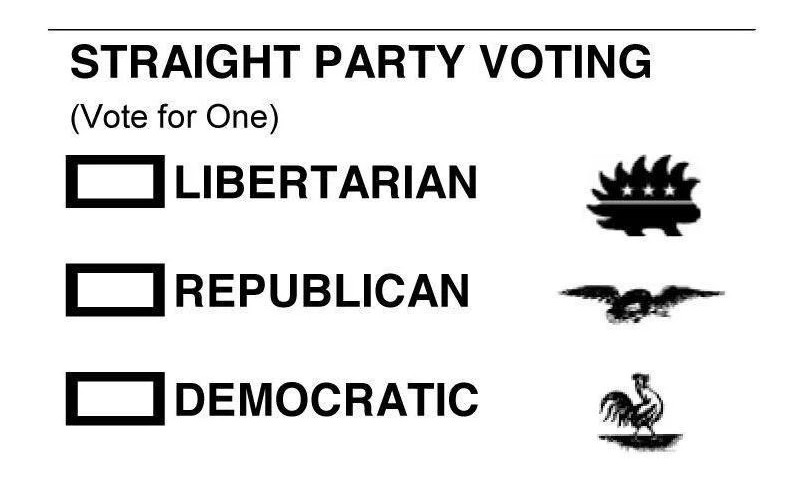
This push to do away with the closed primary and replace it with a jungle open primary is a good example. We should not judge the closed primary by its perceived shortcomings, but we should also consider the positives of the closed primary, and compare it to the negative outcomes that would be imposed by going to a jungle primary.
As Calvin Coolidge, one of the wisest of presidents, once said, “It is better to kill a bad bill, than to pass a good one.”
The next time someone says some inane comment like, Well, change is good, you might want to bring up these points made by Chesterton, Coolidge, and Byas.



Latest Commentary
Saturday 31st of January 2026
Saturday 31st of January 2026
Saturday 31st of January 2026
Saturday 31st of January 2026
Saturday 31st of January 2026
Saturday 31st of January 2026
Saturday 31st of January 2026
Saturday 31st of January 2026
Saturday 31st of January 2026
Saturday 31st of January 2026
Saturday 31st of January 2026
Saturday 31st of January 2026
Saturday 31st of January 2026