


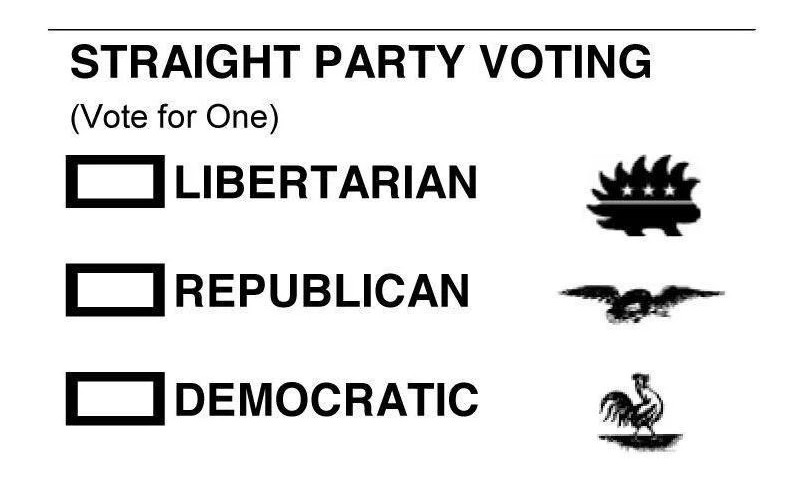
Pictured: Political Party Emblems on Oklahoma Ballots
Oklahoma Primaries Closed to Independents
Oklahoma is a modified closed primary state. In order to participate in a party’s primary or runoff primary election, you must be a registered voter of that party. However, there is an exception, that in every odd-numbered year between November 1 and November 30, state law allows a recognized political party the opportunity to open their primaries and runoff primaries to independents during the next two election years. The chair of the party must notify the Secretary of the State Election Board during the notice period. If at least one party chooses to open its primaries, the deadline is extended to December 15 for the other recognized parties to respond or change their response. If no notice is provided, a party’s primary remains closed.
Ziriax said that although not required by law, he sent out a courtesy notice via certified mail on October 30 to each chair of the three recognized parties about the statutory notice period. He sent another letter on December 3, notifying the parties that none of the parties had provided the notification to open their primaries.
Oklahoma Democratic Party leaders said they were “shocked” to learn that independents would not be allowed to vote in their primary elections. On December 10, Erin Brewer who had just been elevated to be chair of the Oklahoma Democratic Party after the previous chair resigned, issued a press release responding to the news in the election board press release. “The Oklahoma Democratic Party voted overwhelmingly to continue our longstanding policy of including Independents in our primaries at our State Convention in June 2025. The State Election Board was notified of this decision on August 4, 2025. We cannot confirm any further communication from the Election Board on this matter until the issuance of today’s news release.”
Ziriax responded to the claim in the Democratic Party press release. He said the notice the Oklahoma Democratic Party sent to the agency in August was about changing the party’s symbol on the ballot, not about open primaries. But, even if the communication had been about opening the primaries, it was not within the required notification period and was not issued by the chair of the party as required by state law. It is regrettable if the party intended to notify the agency but failed to do so. “It is a done deal,” Ziriax said.
The August 4, 2025, notification cited in the Democratic Party press release was an email from Kati Cain, Oklahoma Democratic Party state secretary. The subject line of the email said, “Changing the Democratic Emblem on Oklahoma Ballots.” The email said:
“This memo is to inform the Oklahoma State Election Board that on Sunday, June 29, 2025, the Oklahoma Democratic Party voted to change the Democratic emblem on Oklahoma Ballots from the current rooster to a donkey. The attached image is of a donkey used by the Democratic National Committee and better represents the Oklahoma Democratic Party today.
The signed minutes from our state convention are attached.
Please let us know if anything else is required for the Oklahoma State Election Board to facilitate the requested change.”
While the email made no mention about independents being allowed to vote in their primaries, Democratic Party leaders tried to create a false narrative. Lauren Craig, Oklahoma Democratic Party executive director, explained to The Oklahoman newspaper that the email included the minutes from its June 29 State Convention where the party voted to continue its policy of including independents in its primaries.
Here is how the liberal-leaning The Oklahoman newspaper slanted this information to their readers: “The Oklahoman reviewed that Aug. 4 email that confirmed Kati Cain, Oklahoma Democratic Party state secretary, sent the Election Board the convention minutes that included the party’s vote to keep its primary open to independents. Cain’s email also included the party’s request to change its emblem.”
Brewer said that the party was working closely with the State Election Board to resolve the matter and are committed to ensuring independent voter access to their primary ballot. “Oklahoma Democrats welcome independents in our elections,” said Brewer. “We value their voices in selecting our general election candidates. We are working with the State Election Board to correct this error and exploring legal counsel if necessary.”
One may wonder what the story is about changing the Democratic Party emblem. Oklahoma is one of only six states still allowing straight-party voting, also known as straight-ticket voting, in general elections. Straight-party voting enables a voter to select one political party’s complete slate of candidates for every office in a category, such as federal or state offices, by making a single mark in a box on his or her ballot. And, next to each party name is an emblem for the party.
The rooster, which has been the symbol of the Democratic Party on ballots in Oklahoma elections since statehood, will be replaced by the donkey symbol of the national party. So, the donkey will appear on Oklahoma ballots beginning with the 2026 general election for straight party voting.
When Democrats were in the majority in Oklahoma, voting straight party for Democrats was referred to as, “Stamping the rooster.” Why was the rooster the emblem for the Democrats? About the year 1840 there was a Democrat candidate in Indiana named Joseph Chapman who was known in all his neighborhood for his gift of crowing like a rooster in his speeches. In 1842 and 1844, after Democratic victories in those years, the rooster came into general use as the emblem of Democratic victory.
The modern representation of Democrats as a donkey dates back to the 1870s. Political cartoonist, Thomas Nast, in Harper’s Weekly adopted the donkey to represent Democrats and the elephant for Republicans in his political artwork. After that, others followed his lead and continued to connect the animals to their respective parties, but only recently has it been adopted as party emblem for merchandise sold by the Democratic Party.
If independents wish to vote in the primary elections this year, they can change their registration to one of the three recognized parties and vote in that party’s primaries. Voters who would like to change their party affiliation should do so before April 1, 2026. State law prohibits party affiliation changes April 1 through August 31 of even-numbered years. Party changes submitted during the closed period will be processed on September 1, 2026.



Latest Commentary
Friday 24th of July 2026
Friday 24th of July 2026
Friday 24th of July 2026
Friday 24th of July 2026
Friday 24th of July 2026
Friday 24th of July 2026
Friday 24th of July 2026
Friday 24th of July 2026
Friday 24th of July 2026
Friday 24th of July 2026